The demand for industrial halls is driven by the growing car industry. Companies respond to geopolitical instability
About 230,000 m² of modern warehouse and production space was newly occupied in the Czech Republic from January to the end of March. Gross demand including renegotiations amounted to 422 thousand m². The main accelerator was the automotive industry, which reported the strongest production volume in the history of the Czech Republic in the period under review. And it is the automotive industry that is driving growth in other sectors, including logistics.
However, according to a quarterly analysis by real estate consultancy 108 REAL ESTATE, an interesting shift is taking shape: while automakers are responding to the oil crisis in the Middle East with increased demand for electric or hybrid vehicles, the industrial real estate market is seeing growing interest in halls with their own energy solutions - most often with a photovoltaic power plant supplemented by battery storage. The total supply of fully completed A-standard industrial halls reached 12.8 million m² at the end of the first quarter.
"Energy independence and decarbonisation are pulling the market upwards despite higher prices. We also see the drive to be as independent as possible in the changed demands for industrial space. Companies are investing in smart warehouses with a higher level of automation, which affects the requirements for technical parameters of leased halls," adds Jakub Holec, CEO of 108 REAL ESTATE.
Industrial buildings with a higher added value are increasingly important in completed projects. There are now 992,349 m² of industrial space under construction in the Czech Republic. A further 525,000 m² are in the shell and core phase. Between January and March, 290,000 m² of new logistics and manufacturing space was completed.
The first months of this year have shown that the industrial space market is responding to the global geopolitical situation. The trend of nearshoring continues, with manufacturing, retail and logistics looking for capacity as close as possible to customers and buyers. This is reflected in the increased demand for logistics and manufacturing space in the Czech Republic and the Central European region in general. As a result, the vacancy rate fell to 4.76% in the first quarter of this year. Key leases and renegotiations were associated with 108 REAL ESTATE, which has the highest share of 27% in the total volume of concluded lease contracts in premium space.
The uncertainty surrounding developments in the Gulf region, with its impact on fuel prices and availability, is having a negative impact on logistics operators in particular. This is particularly the case for 3PLs, many of which have pre-positioned significant warehouse capacity in the previous period. These are now gradually becoming available for additional tenants or subtenants, which is having an impact on rent compression, at least in some regions.
"The pressure on rents is mainly in the vicinity of Pilsen and Ostrava, where less industrial space was leased than usual in the first quarter. However, the market moves in cycles: attractive conditions due to the overhang of supply will, in our opinion, be reflected in increased interest of tenants and investors in the coming months," believes Matěj Indra, Head of Industrial Agency at 108 REAL ESTATE.
According to him, the described trend is also visible in the current tenders of 3PL operators, who have started to demand new premises in large numbers - however, much smaller areas than in previous years.
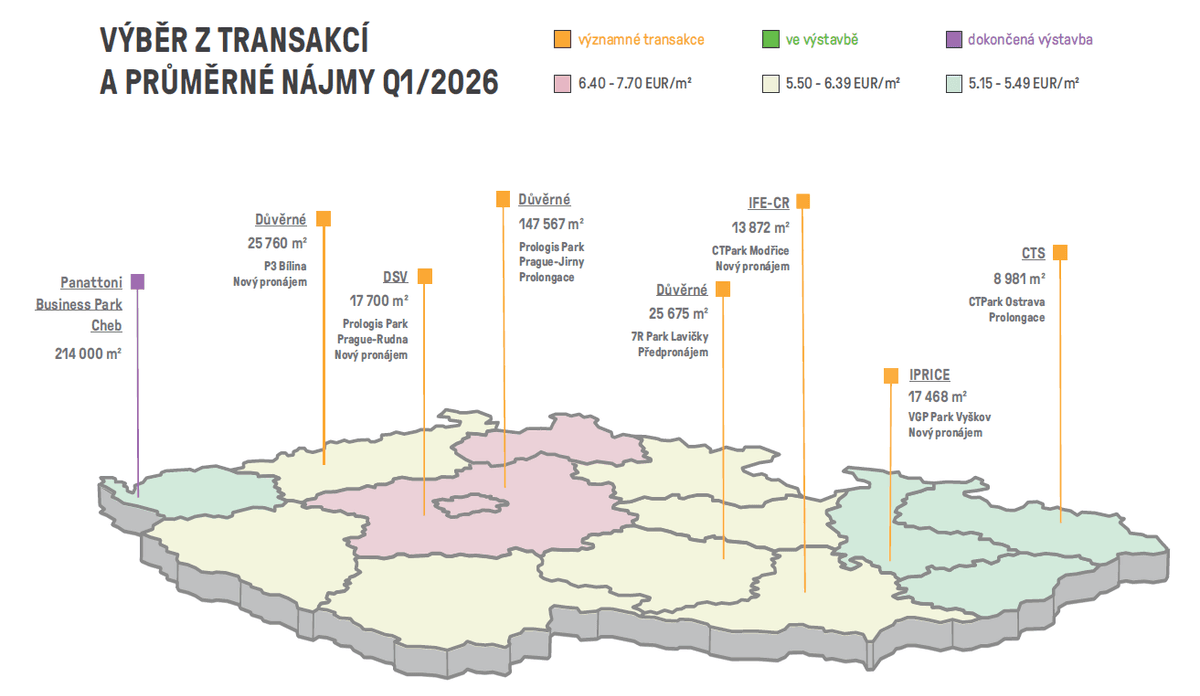
The highest achieved rents for the most modern industrial space in the vicinity of Prague and Brno reached EUR 7.7/m²/month. The average rent achieved is EUR 5.93/m²/month. However, there are significant differences by region and quality of warehouses and production halls.
In terms of tenants, the two most significant developments took place in the Karlovy Vary region, specifically in Cheb. In the first quarter, the largest industrial hall was completed - in Panattoni Business Park Cheb. 214,000 m² was pre-leased to H&M on a long-term basis. At the same time, the intention to build a new Mercedes-Benz Trucks production plant in the region with a capacity of up to 25,000 trucks per year was officially announced. The new plant is expected to employ around 1,100 people in various positions, which could provide a significant boost for this economically weaker part of the Czech Republic. It will undoubtedly also have a synergistic positive impact on the local industrial space market.
Other lease transactions that caught the eye were those of the multinational transport and logistics company DSV (17,708 m² in Prologis Park Prague-Rudná), an undisclosed logistics tenant in 7R Park Lavičky on D1 (25,484 m²) or 25,760 m² for an undisclosed tenant in P3 Park Bílina.
"Compared to previous periods, we see a number of leases between 5 and 10 thousand sqm. These are often expansions or new leases, which demonstrates confidence in the domestic economy or the overall stability of Central Europe," adds Matěj Indra.
A curiosity is the meteoric rise in demand for space suitable for padel. This indoor sport combining elements of tennis and squash, which is experiencing a boom in player interest, has excellent facilities in industrial premises. In addition, it can be a good addition for employees of industrial sites. Most recently, a padel court is opening in CTPark Brno.